
Turning a Local Bill into an English Proof of Address: 4 Field-Tested Routes for Overseas KYC
One-line takeaway: The real blocker in overseas bank/brokerage/payment KYC is rarely "no bill" — it's that your bill is in a language the reviewer can't verify. Here are four routes to convert a local-language bill into an accepted English proof of address, ranked by effort: English bank statements, English credit card statements, telecom/utility bills, and certified translation.
The bottom line: the problem isn't the bill, it's the language
When opening an overseas bank, brokerage, or payment account from home, the address-proof step usually stalls for one reason: your bill is in your local language, with your name and address in non-Latin script, and the reviewer can't verify it. The fixes fall into four routes, easiest first:
- Export an English version of your bank statement from your banking app/online banking (cleanest — the bank issues the English version itself);
- English credit card statement (same logic; Wise and IBKR both accept these);
- Telecom/utility bills (a half-broken route: landline/broadband works, mobile phone bills are explicitly rejected by several institutions);
- Certified translation of your local-language bill (the universal fallback — accepted everywhere, costs money and time).
First, align on what the institutions actually require.
What you need before you start
- Your passport: the romanized spelling of your name on the bill must match your passport letter for letter (case and spaces count).
- One bill issued within the last 3 months: bank/credit card statement or utility/landline bill showing your name and full residential address.
- Address consistency: the residential address on your application must match the address on the bill.
- An officially exported PDF: download it from your bank's app/online banking or the provider's official channel. Screenshots and phone photos don't count — they're editable, so reviewers treat them as worthless.
Cost: routes 1–3 are essentially $0; route 4's notarized/certified translation is itemized below.
Step 1: Align on the hard requirements first
Check the official wording before preparing anything. Wise, IBKR, and Hong Kong banks all converge on the same four elements: third-party issued + full name + complete address + issued within 3 months + issuer identification.
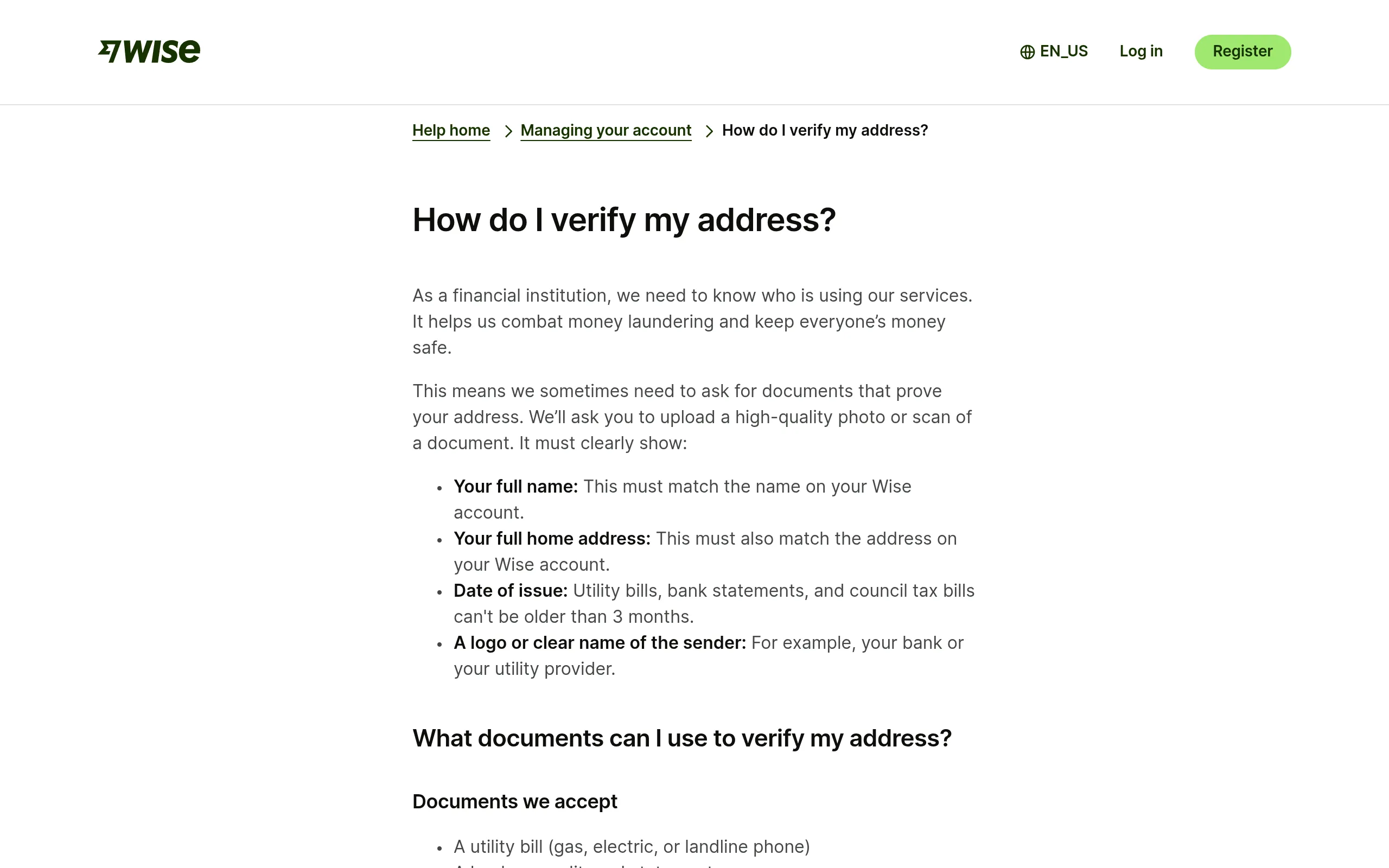
- Wise (official help page): the document must clearly show your full name (matching your Wise account), your full home address (matching your account address), the date of issue (utility bills, bank statements, council tax bills no older than 3 months), and the issuer's logo or name. Accepted: utility (gas/electric/landline) bills, bank or credit card statements. Explicitly rejected: mobile phone bills, PO box addresses, and Wise's own statements.
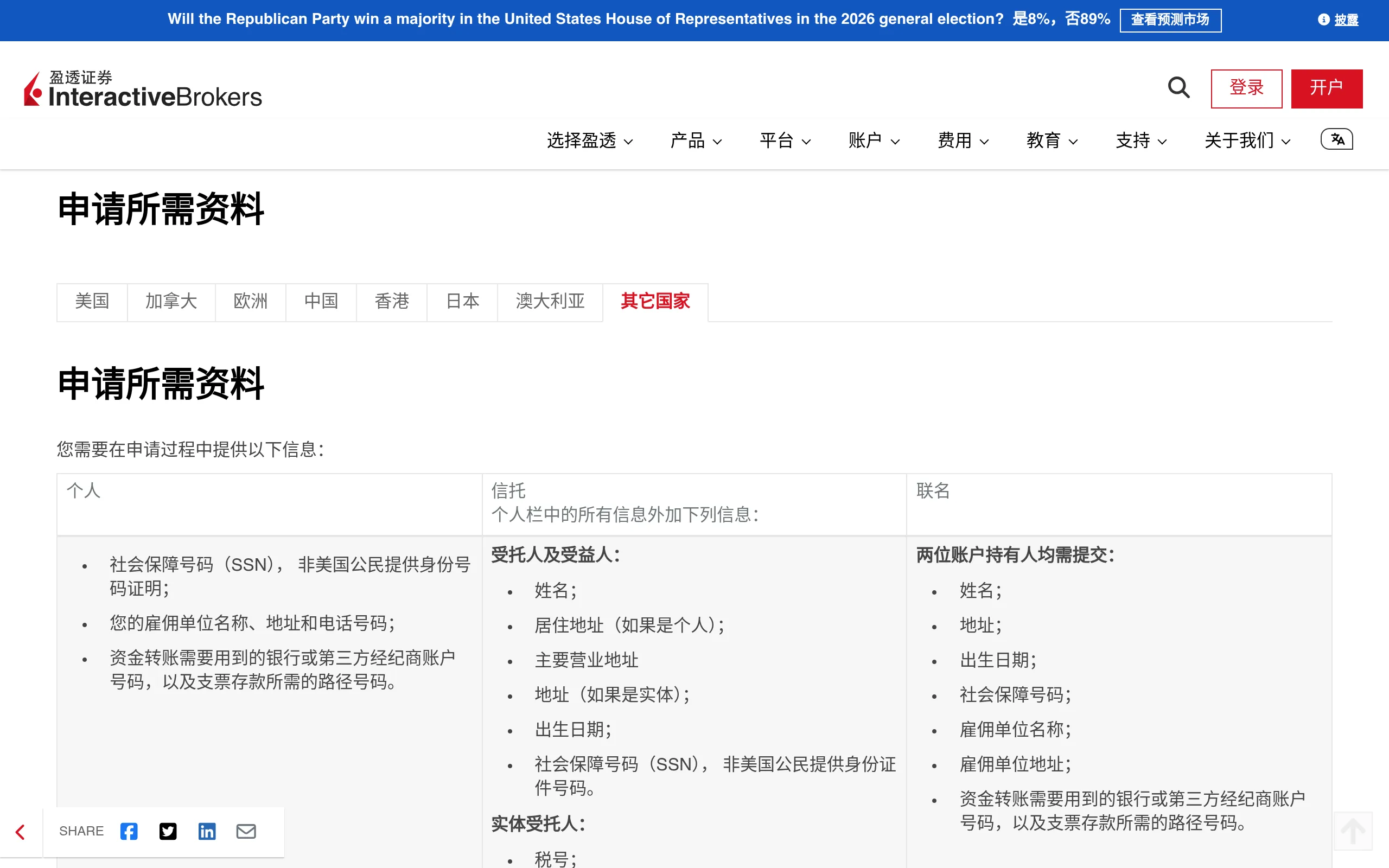
- Interactive Brokers (official "what you need" page): accepted address proof includes utility bills (within 12 months), bank-issued credit card statements, and bank statements (within 12 months, showing full name and current address; the bank must be in an FATF member country). One regional page explicitly states mobile phone bills are not accepted.
- Hong Kong banks (HKMA 2025 guidance, per 2026 field reports): proof of address must be within 3 months and carry the issuer's stamp or electronic seal — anything older or unstamped is rejected outright. Over 60% of individual rejections reportedly trace back to address proof.
Memorize these four elements; every route below is just a way to satisfy them.
Step 2: Routes 1 & 2 — English bank / credit card statements (the smoothest path)
This is the best effort-to-result ratio: an English version issued by the bank itself gives you romanized name, English address, date, and bank logo in one document. Wise accepts both; IBKR accepts bank-issued credit card statements and bank statements.
Debit-card statement vs. credit card statement — which one?
- If either has an English version, use it. Wise accepts both; IBKR accepts bank-issued credit card statements and bank statements.
- Pick whichever shows the most complete address: some banks' e-statements hide the address by default — check the export settings for a "show address" option.
How to do it (generic path): banking app or online banking → statements / account statements → look for an "English" version or language toggle → export as PDF.
Unverified note: I could not find official documentation or a reliable field report confirming the exact in-app location of the "English statement" option at major banks, and menu layouts change between app versions — so I'm not writing a "tap three times" tutorial here. The reliable move is to call your bank's customer service line and ask directly whether they can issue an English-language statement. If they can't, go straight to the certified-translation route in Step 3 instead of improvising.
Triple-check the export yourself: ① romanized name matches your passport exactly; ② English address is complete down to the unit/house number; ③ date is within 3 months. If any fail, pick a different bill — don't upload hoping "it'll probably pass."
Step 3: Route 3 (telecom bills — half-broken) + Route 4 (certified translation — the fallback)
Route 3: Telecom bills — landline/broadband can work, mobile bills won't
The hard boundary first: mobile phone bills are explicitly rejected by Wise's official help page and by IBKR's regional requirements page. That's policy, not luck — don't spend time on it.
What can work is a landline or broadband bill: Wise's accepted list reads "gas, electric, water, landline." If a landline or broadband account is in your name with your address on the bill, it's usable.
Unverified note: I found no reliable documentation on how to obtain an English version of a telecom bill, and given that mobile bills are rejected outright anyway, I'm not expanding this route — if you go this way, prefer landline/broadband and confirm the English-version option with your carrier's customer service first.
Route 4: Certified translation of your local-language bill — accepted everywhere
Can't get an English statement? Then: original local-language bill + a certified English translation from a notary public or licensed translation service. An institution-backed translation is accepted by virtually all overseas institutions.
Typical costs (compiled from 2026 notary-office reports; varies by country/city):
- Notarization: roughly the equivalent of USD 30–70 per document;
- English translation: roughly USD 10–20;
- Extra certified copies: a few dollars each;
- Rush service: extra 20–50% (skip it if you're not in a hurry).
Many notary offices now accept fully online applications: upload scans of your ID and the bill, verify identity over video call, and receive the notarized translation by mail in 3–5 business days. Confirm the target language is English before submitting — re-issuing in the wrong language costs you twice.
Banks take address proof seriously — it's not a formality. One official example:
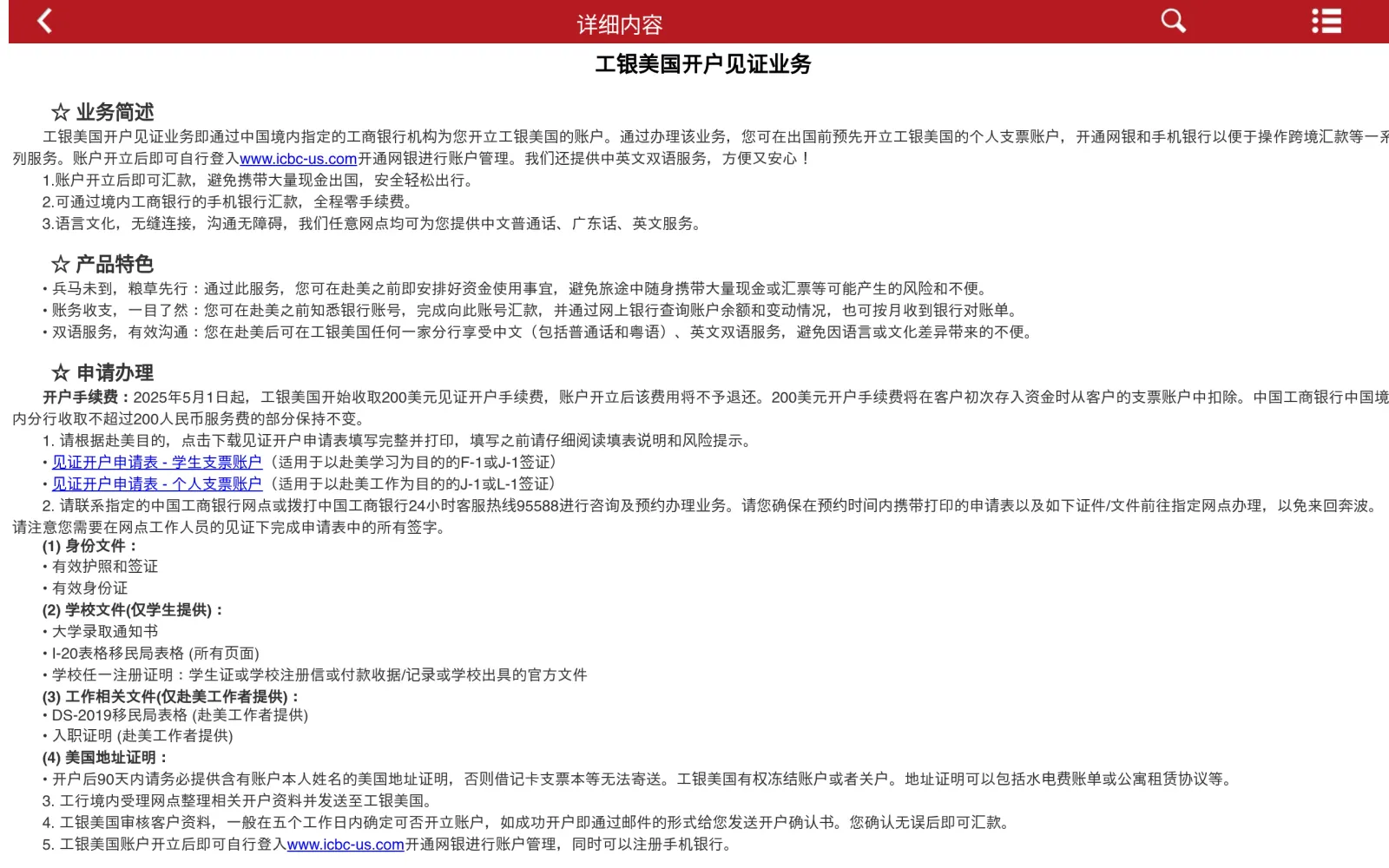
ICBC's official page for its US witness account-opening service states: within 90 days of account opening you must provide a US proof of address in your own name (utility bill or apartment lease); otherwise your debit card can't be mailed and ICBC USA may freeze or close the account. Address proof can be re-checked after opening — so get the four elements right the first time.
Costs, limits, and gotchas — cheat sheet
| Item | Status |
|---|---|
| Universal hard standard | Third-party issued, full name, complete address, within 3 months, issuer identification; romanized name = passport |
| Routes 1 & 2: English bank/credit card statement | Smoothest, ~$0; exact in-app location unverified — confirm with your bank's customer service |
| Route 3: telecom bills | Landline/broadband acceptable; mobile phone bills explicitly rejected by Wise and IBKR; English-version channel unverified |
| Route 4: certified translation | ~$30–70 notarization + ~$10–20 translation + copies + rush fee; online application possible, 3–5 business days by mail |
| Submission format | Officially exported PDF; screenshots/photos are invalid |
| Biggest pitfalls | Incomplete address (missing unit number), name spelling mismatch vs. passport, expired bill, mobile phone bill |
| Timing | Paper bills take 3–7 business days by mail; certified translation 2–5 business days — don't start the day before you apply |
| Red line | Never Photoshop or "generate" a bill — forged documents get you blacklisted by risk teams |
Sources
- Wise official help, "How do I verify my address" (four requirements; accepted/rejected list): https://wise.com/help/articles/2949804/how-do-i-verify-my-address
- Interactive Brokers official "What you need" page (address-proof documents; credit card statements / bank statements): https://ndcdyn.interactivebrokers.com/cn/general/what-you-need-inv.php
- Interactive Brokers regional application-requirements page (bank statements within 3 months; mobile phone bills not accepted): https://www.interactivebrokers.com/cn/index.php?f=5026&nhf=T
- ICBC official page, US witness account-opening service (US proof of address required within 90 days or account may be frozen/closed; $200 service fee): https://m.icbc.com.cn/page/721853156991320067.html
- Xunjie Caishui, "Hong Kong account address proof rejection guide" (2026-09-24; six rejection patterns; paper bills 3–7 business days; translation/notarization 2–5 business days): https://www.szxjcs.cn/news/33414.html
- Baichuan Guihai, "HK account opening self-check guide" (2026-10-13; HKMA 2025 guidance: within 3 months + issuer seal; 60%+ of individual rejections are address-proof issues): https://www.zhucehk.com/company-bank-account-services/6564.html
- Notarization fee breakdown, "How much does a birth-certificate notarization cost?" (2026-10-15; ~CNY 500 notarization, ~CNY 100 translation, CNY 50/copy, CNY 100–300 rush; online "ZhiShangTong" mini-program, 3–5 business days): https://cusdjy.com/2c2d57c2f0c88cda/3bd3bc1af5329a23.html
(Podcast note: I also searched Chinese outbound/indie-dev podcasts on Xiaoyuzhou, Apple Podcasts, and Spotify for episodes about proof of address or overseas-account KYC — none found, so no podcast citation.)