
Gemini 4 Carbon Is Here — but Almost Nobody Can Use It Yet
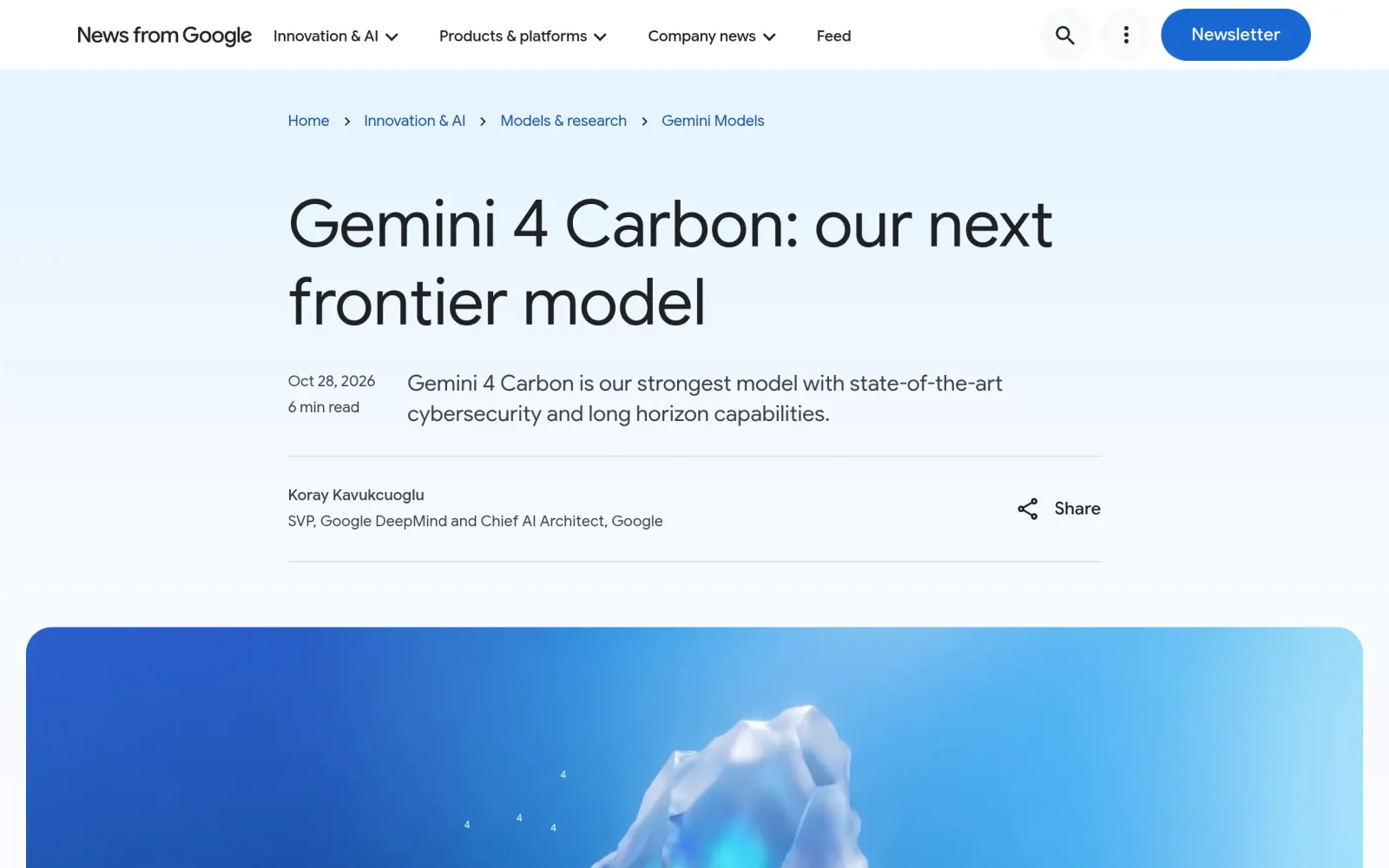
One-line takeaway: On 28 October 2026, Google DeepMind announced Gemini 4 Carbon, its strongest model yet, built for cybersecurity and long-horizon engineering work — and it topped the independent Artificial Analysis Intelligence Index v5 at 59 points. But "announced" is not "available": first access goes to a small group of cyber defenders, with no public date for developers, businesses, or consumers. Today's guide is about verifying the news, waiting correctly, and avoiding the scams that always follow a launch like this — not about pretending there is a sign-up form.
What you need
- No registration, no payment — because there is currently no public sign-up to complete
- One rule to hold onto: any third-party link claiming "Carbon access, pay to join" should be treated as a scam
- If you need Gemini today, your target is the previous model, Argon — not Carbon
Steps
Step 1: Read the official announcement and separate "announced" from "available"
Open Google's official blog post on Carbon (28 October 2026, by Koray Kavukcuoglu). The opening line calls it "our strongest model with state-of-the-art cybersecurity and long horizon capabilities" — but the rollout paragraph is explicit: starting this week, Carbon goes to a subset of cyber defenders, then gradually to additional trusted partners through the Fairwind Program, gathering feedback and iterating on guardrails before reaching developers, businesses, and consumers "as soon as possible." No date, no public application form, no API model ID. With all three missing, there is no honest "how to sign up" section to write.
Step 2: Compare the independent ranking with the vendor's own scores — do not trust one side alone
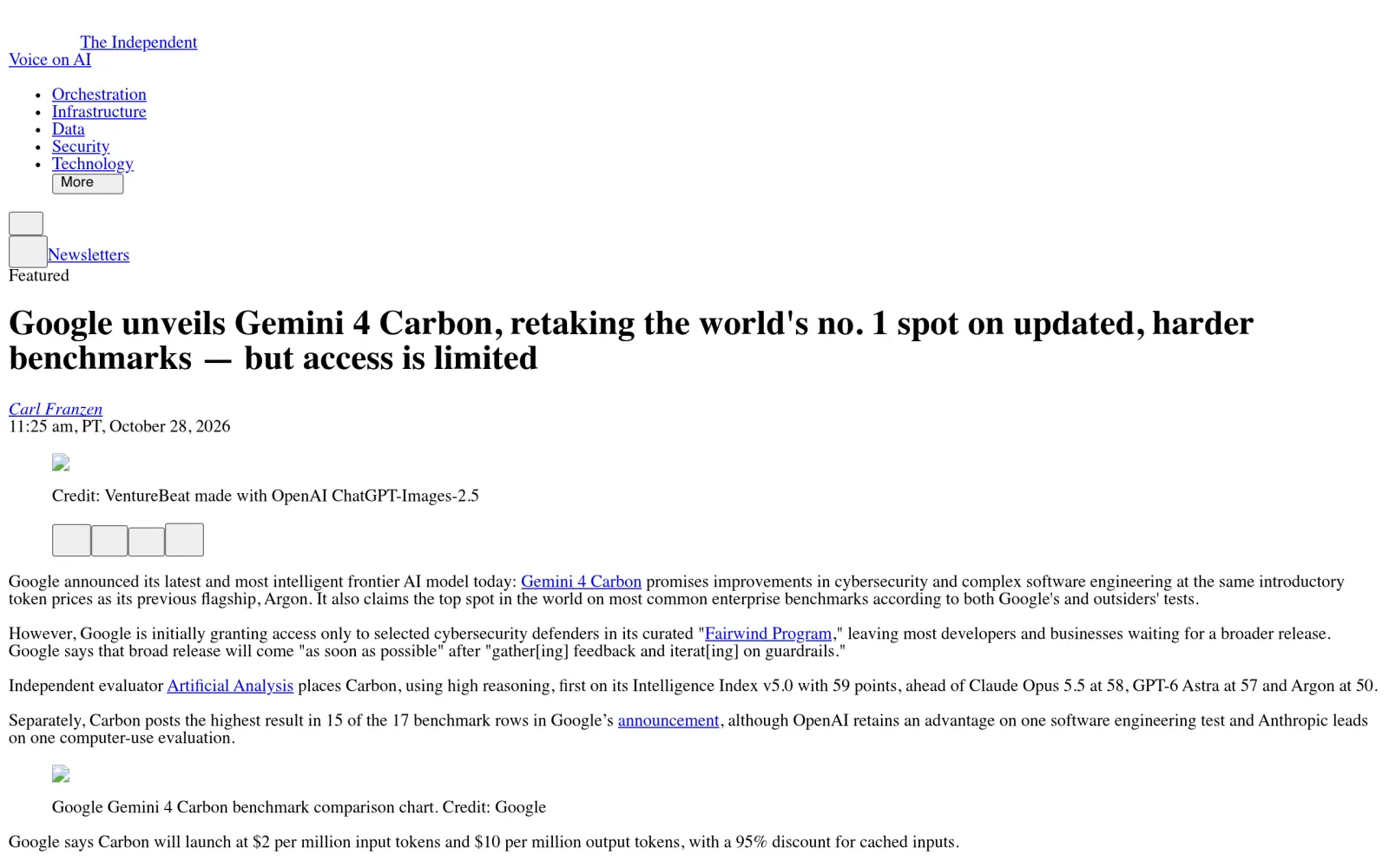
VentureBeat's report puts both sides together: the independent evaluator Artificial Analysis scores Carbon (High) at 59 on its Intelligence Index v5, first overall, ahead of Claude Opus 5.5 at 58, GPT-6 Astra at 57, and the previous model Argon at 50. Google's own security scores are 88.2% on SEC-bench Pro for finding vulnerabilities, 71.0% on CWE-bench for patching, and 54.8% on ExploitGym, with secure-code generation more than twice Argon's success rate on internal benchmarks. The same report notes the other side: Carbon trails rivals on some professional tasks and records a higher hallucination rate than Argon on one factual-knowledge test; Google says its external security benchmarks were evaluated without guardrails, and its "10x better than another lab's model" Chrome claim does not name the rival. Treat vendor scores as positioning evidence, not as independently reproduced results.
Step 3: Work out the price, then set a waiting strategy — here is what to do now
Reuters' 28 October 2026 report confirms pricing: Carbon launches at $2 per million input tokens and $10 per million output tokens, with cached input 95% cheaper — matching Argon's introductory price. After the introductory period, the price rises to $4 and $20, and Google has not announced when that period ends. For ordinary readers, the waiting strategy is three lines:
- If you need Gemini now: Use Argon's API and product lines. Carbon's price and capability are paper figures until it is actually available.
- If you are a security team or critical-infrastructure operator: Learn what the Fairwind Program is for — national cyber authorities, critical infrastructure operators, and core technology platforms, restricted to defensive and academic research use. It is not a consumer queue.
- If you are an individual user: Watch only two official signals — further Google blog announcements and Artificial Analysis index updates. Ignore every "Carbon beta group" and "Carbon top-up portal."
Notes, costs, and pitfalls
- Cost (paper price, not yet buyable): Introductory $2 input / $10 output per million tokens, cached input 95% off; later $4 / $20. Until there is a public API, this price buys nothing.
- Difference from GPT-6.1 Terra: Terra (announced 26 October) came with a clear availability scope — ChatGPT Work and Codex. Carbon (announced 28 October) came with a scope limited to "a subset of defenders." The two announcements are not equivalent, and an announcement date is not a launch date.
- Context window: Third-party model listings put Carbon at 1 million tokens of context; Google's announcement text does not state this figure, so this guide attributes it to third-party listings rather than presenting it as official.
- Pitfalls: ① Never pay for a "Carbon account" or "Carbon API key" — that is the classic post-launch scam window. ② Do not read 59 points as "best at everything" — the index combines nine evaluations, and OpenAI and Anthropic each lead individual tests. ③ Do not use Carbon's security scores to justify offensive testing — Fairwind restricts dual-use work to defensive and academic research.
Sources
- Google official announcement (28 October 2026): https://blog.google/innovation-and-ai/models-and-research/gemini-models/introducing-gemini-4-carbon/
- Reuters (28 October 2026): https://www.reuters.com/technology/google-launches-gemini-4-carbon-ai-model-with-cybersecurity-focus-2026-10-28/
- VentureBeat report (independent ranking and trade-offs): https://venturebeat.com/technology/google-unveils-gemini-4-carbon-retaking-the-worlds-no-1-spot-on-updated-harder-benchmarks-but-access-is-limited
- Model listing (1M context, no public API ID): https://handyai.substack.com/p/model-drop-gemini-4-carbon
- Same-day AI news roundup: https://thediaryofai.com/ai-news-20261028/